Assessment Area 2: Economic Opportunity
A strong regional economy depends on communities where people can afford to live, businesses can invest, workers can find employment, land is available for commercial and industrial activity, and municipal services support quality of life. Municipal influence here is broader than taxation. Councils shape business conditions through land-use decisions, employment land availability, commercial and industrial zoning, tourism and accommodation policy, permitting speed and regulatory predictability.
The figures below should be read as a starting point for discussion rather than a complete measure of competitiveness.
Municipal Property Tax Rates and Business Tax Multipliers
The business tax multiplier is the ratio of the business property tax rate to the residential rate. A multiplier of 3.0 means business properties pay three times the municipal rate residential properties pay on the same assessed value.
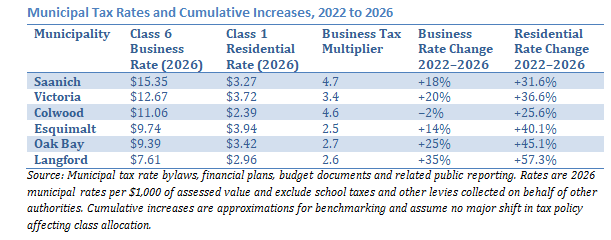
Saanich has both the highest business rate at $15.35 and the highest multiplier at 4.7. Langford has the lowest business rate at $7.61. Esquimalt has the highest residential rate at $3.94 and Colwood the lowest at $2.39. Victoria and Oak Bay sit near the regional middle on both. Across the six municipalities the multiplier averages 3.4.
Municipal taxes have risen faster than inflation everywhere in the region since 2022. Langford recorded the steepest cumulative increases on both classes, 35 per cent on business and 57.3 per cent on residential. Colwood is the only municipality reviewed to reduce its business rate, down 2 per cent. The residential increases range from roughly 5.9 per cent a year in Colwood to 12.0 per cent a year in Langford, against a long-run provincial inflation benchmark of 2.2 per cent.
The question residents should ask candidates is not whether taxes rose, but whether service levels, infrastructure and community outcomes improved enough to justify the increase.
Spending Growth Compared with Population and Inflation
Where spending grows faster than population, residents are entitled to understand what was achieved in return. The comparison below sets real operating spending growth against population growth and the provincial inflation benchmark over the same period.
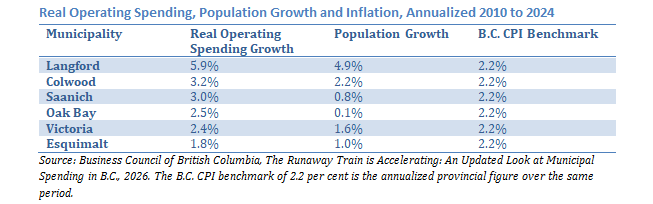
In all six municipalities, real operating spending grew faster than population, so population growth alone does not explain the increase. Langford’s spending grew fastest at 5.9 per cent annually, though it also had by far the fastest population growth at 4.9 per cent. The widest gaps are in Oak Bay, where 2.5 per cent spending growth came against population growth of just 0.1 per cent, and Saanich, where 3.0 per cent came against 0.8 per cent. Esquimalt is the only municipality whose spending growth fell below the inflation benchmark.
The data do not establish a single cause. Municipalities face real cost pressures, downloaded responsibilities and limited revenue tools. The Chamber’s point is narrower: municipalities with larger gaps carry a correspondingly larger obligation to explain what the additional spending bought.