Assessment Area 1: Housing Affordability and Supply
Housing affordability is the most frequently cited challenge facing workers and employers across Greater Victoria. The cost and availability of housing shape labour supply, workforce retention, business investment and regional competitiveness. When people cannot afford to live near where they work, the entire regional economy carries the cost.
Housing affordability and municipal performance are not the same thing. Councils cannot compel a developer to proceed and cannot set market prices. What they do control is approvals, permitting performance, zoning and land-use policy, servicing, and the range of housing forms permitted. This report separates housing outcomes, which describe affordability conditions, from municipal performance factors, which describe what councils actually influence.
Homeownership Affordability
Homeownership is out of reach for a typical household everywhere in the region. Detached benchmark prices exceed $1 million in all six municipalities. Measured against median household income, Colwood and Langford are the most attainable ownership markets at roughly nine times income, followed by Esquimalt at 10 times. Saanich and Oak Bay sit above eleven and twelve times respectively, and Victoria is the least attainable in the region at 14.7 times income, driven as much by the region’s lowest median household income of $85,000 as by price. Full figures appear in the affordability table in the executive summary.
Oak Bay records the highest benchmark prices in the region, confirming its position as the region’s most expensive ownership market. Condominium ratios are materially lower everywhere, ranging from 4.1 times income in Colwood to 5.9 times in Victoria, which is why multifamily supply matters so much to attainability.
Housing Delivery
This section assesses whether municipalities are helping create the conditions for housing supply to improve over time. Permit-authorized units are a useful indicator of activity, but they should be read alongside land availability, infrastructure capacity, existing zoning, development economics and community context, which differ substantially across the six municipalities.
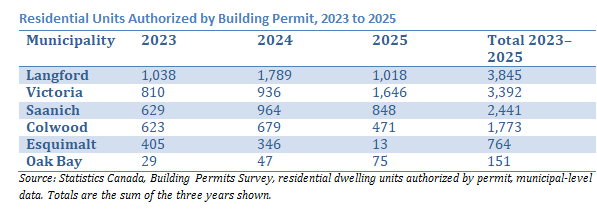
Langford and Victoria are the region’s approval leaders, with Langford leading in 2023 and 2024 and Victoria in 2025. Saanich forms a clear second tier, Colwood has expanded its housing inventory rapidly relative to its population, and Oak Bay’s delivery is low by every comparison available.
Two patterns deserve attention. First, delivery slowed across most of the region in 2025: authorized units fell in Langford, Saanich, Colwood and Esquimalt, with Victoria and Oak Bay the only municipalities to increase. Second, much of Langford’s volume reflects projects already in the development pipeline before the 2022 council term began, which is why approval counts alone are an incomplete measure of a council’s own contribution.
Housing Diversity and Choice
Municipalities that permit a broader range of housing types are better positioned to accommodate population growth, workforce needs and changing household composition. Diversity also does more for attainability than detached supply alone, given the gap between detached and condominium price-to-income ratios.
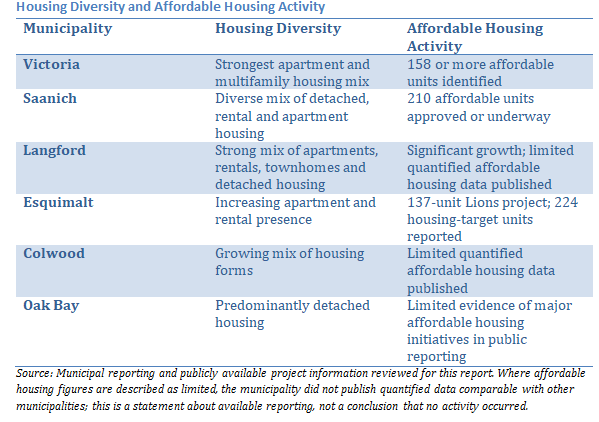
Langford and Colwood show the strongest evidence of supply growth. Victoria and Saanich carry a large share of the region’s multifamily, rental and affordable housing. Esquimalt demonstrates improving diversity within a compact urban footprint. Oak Bay’s profile remains predominantly detached.