Assessment Area 3: Public Safety
Public safety is a foundational responsibility of local government and a precondition for economic confidence. The Chamber recognizes that public safety challenges are complex and often involve issues beyond municipal jurisdiction, including mental health, addictions, homelessness, repeat offending and provincial justice policy. Local governments frequently respond to the visible effects of problems whose policy tools and funding sit with other orders of government.
The Crime Severity Index is Statistics Canada’s severity-weighted measure of police-reported crime, combining how much crime is reported with how serious the offences are. The Violent Crime Severity Index applies the same method to violent offences. Both are reported here for every year of the council term alongside the provincial average.
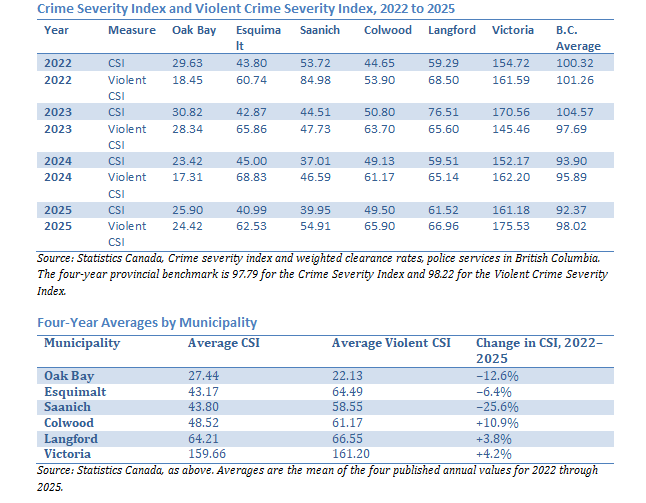
The six municipalities fall into three tiers. Oak Bay records the lowest crime severity in the region by a substantial margin, at roughly 28 per cent of the provincial benchmark. Saanich, Esquimalt and Colwood form a moderate middle tier, all well below provincial levels. Langford records the highest crime severity outside the urban core. Victoria is a clear outlier.
Victoria is the only municipality above the provincial average on both measures in every year from 2022 to 2025, averaging 63 per cent above the benchmark on overall crime severity and 64 per cent above on violent crime severity. Both measures worsened over the term while the provincial averages improved, with the provincial crime severity index falling from 100.32 in 2022 to 92.37 in 2025.
Saanich recorded the region’s strongest improvement, with crime severity down 25.6 per cent and violent crime severity down 35.4 per cent over the four years. Oak Bay improved 12.6 per cent from an already low base. Colwood’s violent crime severity rose 22.3 per cent, the largest increase outside Victoria, though it remains below the provincial benchmark. Esquimalt’s overall severity improved while its violent measure edged up.
The regional conclusion is genuinely positive and worth stating plainly: five of six municipalities outperformed provincial public safety benchmarks throughout the term. Public safety pressure in the Capital Region is concentrated, not general, and it is concentrated in the urban core that the entire region depends on.