“Small” Tax Increases Add Up to Big Costs for Families
Across the Capital Region, 13 municipal councils are making decisions that directly affect affordability, public safety, investment, and the cost of doing business. One of the most visible impacts of these decisions is property taxes.
Last week, seven of the region’s 13 municipal councils voted on their 2026 property tax rates. Under B.C.’s Community Charter, municipal councils must adopt their annual property tax rate bylaws before May 15 each year.
For our members, the question is unavoidable: how are local government decisions affecting the conditions needed to run a business in Greater Victoria?
To help inform that conversation, the Greater Victoria Chamber of Commerce is tracking and comparing business tax rates across the region’s 13 municipalities.
Provincial Government Downloading Costs to Municipalities
We recognize the challenges local governments are navigating. Municipalities are increasingly responding to service gaps related to housing, homelessness, and mental health, while also working to meet new provincially mandated housing targets. These responsibilities have increased municipal workloads and costs, often without corresponding funding.
Thirteen Councils. One Region.
Last week, seven councils voted on property tax rates. Reported 2026 property tax increases, from lowest to highest, are as follows:
- Colwood +4.22%
- North Saanich +5.5%
- Central Saanich +7.37%
- Oak Bay +8.42%
- Sidney +9.37%
- Sooke +10.5%
- Esquimalt +11.3%
The remaining six municipalities are currently operating with proposed tax increases. While nothing is final until councils adopt their bylaws, the following figures have been reported publicly to date:
Proposed Tax Increases (Not Final)
- Metchosin +3.88%
- Saanich +5.35%
- Victoria +7.28%
- View Royal +8.69%
- Highlands +9.9%
- Langford +10.22%
It is important to carefully examine these increases. “Every municipal tax increase, no matter how small, compounds annually and raises the cost of doing business in Greater Victoria. Taxpayers deserve clear, accountable outcomes for how their money is spent,” indicated John Wilson, CEO of the Greater Victoria Chamber of Commerce.
Business Property Tax Rates
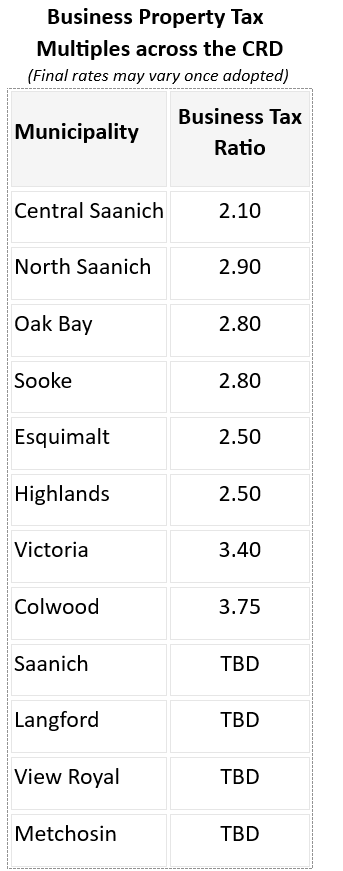 Business property tax rates are set using property tax “multipliers,” which indicate how many times the municipal portion of the business property tax rate (Class 6) is applied compared to the residential property tax rate.
Data note
In some municipalities, the final 2026 business property tax multipliers have not yet been adopted. Where this is the case, the table below reflects the most recent available rates, which may include 2025 multipliers. The comparison is provided to illustrate relative differences across the region, rather than final 2026 rates.
Below is a comparison of business‑to‑residential municipal property tax multipliers for selected Capital Regional District municipalities. The figures reflect municipal taxes only and exclude school and other non‑municipal levies.
Affordability Context
These local property tax decisions are unfolding amid broader public concern about affordability. A recent Angus Reid Institute poll of 2,013 Canadians found that 52% rank reducing the cost of living as the top priority. Seven in ten respondents said governments have fallen short in addressing rising day‑to‑day costs, with housing affordability close behind.
Looking Ahead
As the fall municipal election approaches, the Greater Victoria Chamber of Commerce will continue this work by assessing and comparing municipal policies that affect the ease of doing business across the region. This will include a closer look at property taxes, crime and public safety, and other factors that influence local competitiveness. Our goal is to provide members and voters with clear, data‑driven information to support informed decision‑making.
With Gratitude
Local government councils are faced with complex decisions. We are grateful to the individuals who step forward to serve in elected office and for the time and commitment they dedicate to their communities. Thank you for your service.
We welcome your feedback:
communications@victoriachamber.ca