Some Municipalities Are Taking the Elevator
BizNews’ May 6 “Tax Edit” offered an early look at business taxes across the CRD based on available data. Now, with all municipalities having adopted their 2026 tax bylaws, the full picture is clear.
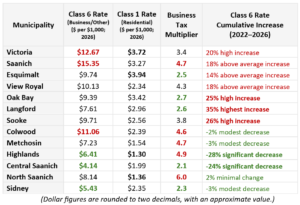
The difference in business tax rates across the CRD is significant. Businesses in Saanich face a Class 6 rate of $15.35 per $1,000 of assessed value, compared to $4.14 in Central Saanich. Victoria also remains on the higher end at $12.67, while several municipalities, including Sidney, Highlands, and Metchosin, maintain comparatively lower rates. For a region that functions as a single economic area, these differences translate into considerations that influence leasing decisions, pricing, hiring, and long-term investment.
Equally important is how the tax burden is distributed. The business tax multiplier (how much more businesses pay relative to residential properties) varies significantly across the CRD. North Saanich has the highest multiplier at 6.0, while Central Saanich sits at 2.1, reflecting a more balanced distribution. This distinction matters because even municipalities with moderate tax rates can place a heavier burden on businesses if the overall structure leans too heavily on the business sector.
Different Municipalities, Very Different Bills
A simple example illustrates the impact. A business property assessed at $1 million in Saanich would pay approximately $15,350 in municipal taxes in 2026. The same property in Central Saanich would pay about $4,140.
Several municipalities have implemented notable business tax increases over the past four years, including Langford at 35%, Sooke at 26%, Oak Bay at 25%, and Victoria at 20%. At the same time, others, such as Central Saanich and Highlands, have reduced business tax rates, while Sidney and Colwood have remained relatively stable.
Better Choices Mean Lower Taxes
Municipalities across the region are managing legitimate cost pressures, including costs downloaded from the provincial government. But councils have choices. Not all spending is directed to essential services, and discretionary spending plays a significant role in determining how much residents and businesses ultimately pay in taxes.
High or rapidly rising business taxes influence investment decisions and overall business confidence. Conversely, municipalities that maintain competitive rates are better positioned to attract and retain businesses, support job creation, and foster economic growth for their community.
The Opportunity
As councils look ahead to future budget cycles, early and meaningful consultation with the business community will help inform better outcomes. A collaborative approach and a shared focus on competitiveness will support stronger outcomes for communities across the CRD.
Comparative Analysis: Tax Rates across the Capital Regional District
The table compares 2026 municipal tax rates per $1,000 of assessed value for Class 6 (Business/Other) and Class 1 (Residential) properties, based on each municipality’s 2026 Tax Rate Bylaw.
Join the Conversation. Shape the Outcome
The Greater Victoria Chamber is here to ensure your voice is heard and your interests are represented. Join the Chamber, share your experience, and stand with other businesses working for fair, competitive policies that support jobs and growth across our region.