Greater Victoria Municipal Report Card 2022-2026
A Public Review of Affordability, Economic Opportunity, Public Safety and Governance Across Six Capital Region Municipalities
A Message to our Members
Greater Victoria is one of the most livable regions in Canada. The region has a deep-water port, universities and colleges, a strong technology sector, and a stable public-sector employment base. What it does not yet have is an economy that reliably converts those advantages into consistently high-paying jobs and new investment.
We also know what the past four years have felt like for the people who live here. Nobody reading this report needs to be told that the cost of living is difficult. They are living it.
This is where The Chamber wants to offer its insights in the spirit of public discussion. Affordability will not be solved by housing alone. It is solved by attracting employers and the investment that pays high enough to live here. Housing is only half the affordability equation. The other half is growing incomes. The region has understandably focused more on housing supply and choice. The Chamber would now like to see elected Councils focus on the second piece of affordability – enabling the conditions for a strong local economy.
Municipal spending has to be part of the solution as well. Across the six municipalities reviewed, operating spending grew faster than population growth and inflation combined, and cumulative residential tax increases between 2022 and 2026 ranged from 25.6 per cent in Colwood to 57.3 per cent in Langford. Annualized, Langford’s increase runs at roughly five and a half times the provincial inflation benchmark. Increases at that pace are not sustainable, and they do not stop at homeowners and business. They flow through to rents, and renters pay them without ever seeing a tax notice.
Local government works best when it concentrates on the basics. Roads, water, sewer and drainage, policing and fire, parks and recreation, permitting and inspections are the services residents and businesses depend on, and they are the services councils uniquely control. Council time and taxpayer-funded resources spent debating geopolitical questions, international conflicts and other areas that fall outside the mandate of municipal government, is not effective governance, and this review found many examples of it.
Getting this right is how we protect what makes this region special. Economic prosperity is what pays for parks and recreation, arts and culture, shoreline restoration, the stormwater systems and the climate adaptation this coastal region will need.
Municipalities are being asked to do more with fewer tools, often absorbing responsibilities that belong to other orders of government. They are also increasingly drawn into issues beyond their traditional mandate. We ask only that the next four years be measured by outcomes residents can see and feel, and we are offering benchmarks to help make that assessment possible.

About This Review
This review examines six of the thirteen municipalities in the Capital Regional District during the 2022 to 2026 municipal term: Victoria, Saanich, Oak Bay, Esquimalt, Langford and Colwood. These are the communities where economic activity is concentrated and where municipal decisions carry the greatest weight for employers, workers and residents across the region.
Municipalities are assessed across four areas: housing affordability and supply, economic opportunity, public safety, and governance focus and role clarity. The indicators chosen are those most directly influenced by council decisions during the term, selected against three tests: whether the outcome shapes daily life for the people who live and work here, whether comparable public information is reasonably available, and whether councils can influence the result within their own authority.
The Chamber represents employers, but the measures in this report were chosen because they affect residents first. Whether a family can afford a home near work, whether a street feels safe at night, whether a permit takes three months or eighteen, and whether a tax increase leaves less at the end of the month are questions that reach everyone in a community, employers among them. Where business conditions appear in this review, it is because they determine whether the jobs and incomes that make a community affordable exist at all.
Comparing municipalities is genuinely difficult. Annual reports are not standardized across the region, municipalities do not all publish the same performance measures, and reporting periods vary. This report is a discussion tool, not an audit, a legal finding, or a determination of fact. Where the evidence does not support a firm conclusion, the report says so.
Data Limitations
Two indicators the Chamber wanted to include were excluded because the public information would not support a fair comparison. Staffing data did not allow a reliable assessment of where growth occurred or whether new positions supported core services. Revenue reporting was inconsistent enough across municipalities that comparison would have misled more than it informed.
The Chamber’s view is that these gaps are themselves a finding. Residents cannot hold a council to account for outcomes the municipality does not measure or publish comparably, and standardized regional reporting would cost little relative to the accountability it would create.
Expert Advisory Panel
The letter grades were informed by an independent advisory panel with experience in municipal governance, taxation, public administration and economic policy.
• Carson Binda, British Columbia Director, Canadian Taxpayers Federation
• Christopher Causton, former Mayor, District of Oak Bay, and former chair of the Capital Regional District
• Ida Chong, former Member of the B.C. Legislative Assembly for Oak Bay–Gordon Head, former Cabinet Minister, and former Municipal Councillor for the District of Saanich
• Gary V. Lunn, former Member of Parliament for Saanich–Gulf Islands and former federal Cabinet Minister
• David Saunders, former Mayor and Councillor, City of Colwood, and former Governor, Royal Roads University.
The panel’s role is to provide perspective and to ensure the report contributes constructively to informed public discussion.
Executive Summary
The Chamber’s goal in preparing this report is to show how municipal decisions shape affordability outcomes and provide benchmarks for measuring progress over time.
Affordability does not happen by accident. It is shaped by the decisions made around the council table. Every bylaw, budget, program, and priority comes with costs and trade-offs that are borne by residents, businesses, or both. This report seeks to draw a clear line between municipal decision-making and affordability outcomes, while establishing practical benchmarks against which future progress can be measured.
Civic Engagement
In the 2022 general local election, just under 76,000 ballots were cast across the six municipalities examined here out of approximately 244,000 estimated eligible voters, a combined turnout of 31 per cent. Roughly 168,000 eligible residents did not cast a ballot.
Source: Civic Info BC, compiled and published by CHEK News, October 2022.
The regional pattern is not uniform. Oak Bay recorded the steepest decline of any municipality reviewed, falling 21 points from 54 per cent in 2018 to 32 per cent in 2022. Victoria and Saanich each fell about eight points. Langford was the only one of the six to increase, rising roughly 8 points to 24.0 per cent, though it started from the lowest base on Vancouver Island and remains among the lowest turnouts in the region.
What councils chose to spend their time on was decided by councils elected by 31 per cent of eligible voters. The Chamber believes that higher participation produces clearer direction, and clearer direction produces better regional outcomes.
What the Review Found
• Housing costs exceed what local incomes support everywhere in the region. Detached benchmark prices for a single-family home are above $1 million in all six municipalities, ranging from $1,048,100 in Langford to $1,846,800 in Oak Bay. Measured against median household income, ownership is attainable in Victoria at 14 times income and most attainable in Colwood at 9 times.
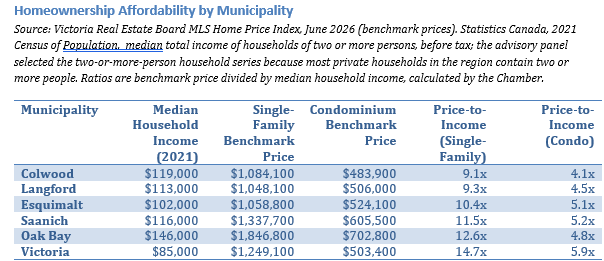
Source: Victoria Real Estate Board MLS Home Price Index, June 2026 (benchmark prices). Statistics Canada, 2021 Census of Population, median total income of households of two or more persons, before tax; the advisory panel selected the two-or-more-person household series because most private households in the region contain two or more people. Ratios are benchmark price divided by median household income, calculated by the Chamber.
Affordability ratios in this report compare 2026 benchmark prices with 2021 Census data should be read as guidance rather than precise multiples. Because incomes have likely risen since 2021, the ratios may overstate the true gap.
• Housing delivery varies enormously. Langford authorized 3,845 residential units between 2023 and 2025 and Victoria 3,392, while Esquimalt authorized 764 and Oak Bay 151.
• Real operating spending outpaced population growth in all six municipalities between 2010 and 2024 and outpaced the inflation benchmark in five of the six. Langford grew fastest at 5.9 per cent annually; Esquimalt grew slowly at 1.8 per cent and was the only municipality below the 2.2 per cent benchmark.
• Business properties carry a disproportionate share of municipal taxation. Business tax multipliers range from 2.5 in Esquimalt to 4.7 in Saanich and average 3.4 across the six municipalities.
• Public safety is a genuine regional advantage. Five of the six municipalities recorded crime severity below the provincial benchmark in every year from 2022 to 2025. However, Victoria’s crime severity averaged 1.6 times the provincial benchmark between 2022 and 2025, the only municipality in the region above the provincial average in every year of the term.
• Governance focus is inconsistent. The review identified examples of council time and municipal resources directed toward ideological and philosophical policymaking, social policy, international affairs and initiatives falling under the mandate of the provincial and federal governments – areas outside municipal jurisdiction, and in some cases, already funded through provincial or federal taxation.
Assessments


Conclusion and Recommendations
The findings show a region with genuine strengths. Public safety across five of six municipalities is better than the provincial average. Housing delivery in Langford, Victoria, Saanich and Colwood has been substantial. Several municipalities have kept business taxation at competitive levels, and one reduced it. These are real achievements by councils working under constraints.
The findings also show consistent pressures. Real operating spending has grown faster than population in every municipality reviewed, and faster than inflation in five of the six. Residential tax increases have run well above inflation everywhere, and those costs reach renters as well as homeowners. Housing remains unaffordable relative to local incomes in all six communities. Council attention has at times been directed to questions that municipal governments have no authority to resolve.
The clearest single recommendation from this review concerns information rather than policy. Annual reports vary considerably in format, benchmark selection and level of detail across the Capital Region, and several indicators the Chamber wanted to examine could not be compared at all. Comparable reporting on permitting timelines, serviced land availability, spending outcomes and affordability measures would cost little and would let residents judge for themselves whether they are getting value for what they pay.
No municipality is perfect, and every community faces its own circumstances. The purpose of this report is not to criticize but to encourage constructive dialogue, informed voting and continuous improvement. The Chamber offers it in that spirit, with the shared goal of building communities that are safe, affordable, prosperous and worth passing on.
Recommendations
Based on the findings of this report, the Chamber offers six recommendations for all thirteen municipalities in the Capital Regional District.
1. Set Clear Goals at the Start of Each Council Term
Municipalities should establish a small number of measurable priorities at the beginning of each term and report annually on progress toward those goals.
2. Standardize Annual Reporting and Financial Transparency
Adopt a consistent, easy-to-read annual report format across municipalities, including key performance indicators, consolidated revenues and expenses, and a plain-language summary of results. The Chamber recommends a short-form report of 10 pages or less.
3. Secure Funding Agreements for Non-Municipal Services
Where municipalities deliver services that are primarily provincial or federal responsibilities, councils should seek formal funding agreements so that local taxpayers do
not pay twice for the same service.
4. Align Spending Growth with Population Growth and Inflation
Operating spending should grow no faster than population growth plus inflation. Any increase beyond that threshold should be accompanied by a clear public explanation of the service improvements or outcomes achieved.
5. Focus on Core Municipal Responsibilities
Council time, staff resources and taxpayer dollars should be directed toward core municipal services and responsibilities.
6. Accelerate Housing Approvals and Reduce Development Costs
Publish permitting timelines, reduce approval backlogs, and keep development charges as low as possible.
Data Sources and References
- Annual Reports (Saanich, Victoria, Esquimalt, Colwood, Langford, Oak Bay).
- Business Council of British Columbia. 2026. The Runaway Train is Accelerating: An Updated Look at Municipal Spending in B.C.
- Canada Mortgage and Housing Corporation. 2025. Rental Market Report: Victoria CMA.
- Civic Info BC. 2022. General local election results and voter turnout, as compiled and published by CHEK News, October 2022.
- Criminal Justice Branch. 2024. Police Resources in British Columbia, 2024. Ministry of Public Safety and Solicitor General, Province of British Columbia.
- Province of British Columbia. 2026. Municipal General and Financial Statistics.
- Statement of Financial Information (SOFI) Report: Local Government Financial Reporting. Ministry of Municipal Affairs and Housing. 2022-2026.
- Statistics Canada. 2022. Census Profile, 2021 Census of Population. Median totalincome of households of two or more people, before tax.
- Statistics Canada. 2023 to 2025. Police-Reported Crime Statistics in Canada, annual editions.
- Statistics Canada. Building Permits Survey, residential dwelling units authorized by permit, municipal-level data.
- Victoria Real Estate Board. 2026, June. MLS Home Price Index and Market Statistics Report.